
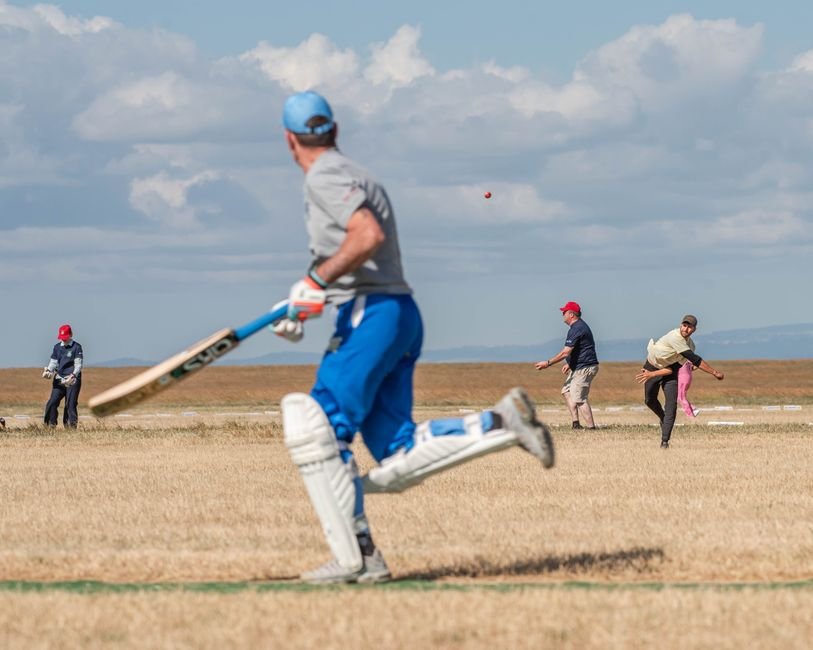
If you are new to cricket, the names of fielding spots can feel like a foreign language. This guide has cricket fielding positions explained in plain English, so you can follow a live match, read a scorecard, or just impress your friends at the next game. No prior knowledge needed. Let us start from scratch.
Table of Contents
The Cricket Field: What You Need to Know First
A cricket field is a large oval or circular ground. At the centre sits the pitch, a 22-yard strip where the bowler (the player who throws the ball) delivers to the batter. The fielding team spreads across the ground to stop runs and take catches.
The field is split into two halves based on the batter’s stance:
Gray-Nicolls Cricket Fielding Positions Poster / Cricket Ground Diagram Chart
Pin up every fielding position at a glance — perfect for beginners following live cricket for the first time.
ⓘ Affiliate link — we earn a small commission if you buy, at no extra cost to you.
- Off side – the side the batter faces when standing at the crease (the batting line)
- Leg side (on side) – the side behind the batter’s legs
Understanding these two halves makes every position name much easier to decode.
Cricket Fielding Positions Explained: The Core Positions
There are roughly 30 named positions in cricket, but most matches use a selection of about 11 at a time. Here are the ones you will see and hear most often.
Close to the Wicket
These fielders stand very near the batter, ready for edge catches. They require sharp reflexes.
- Slip – stands behind and to the off side of the batter. First slip is closest to the wicketkeeper, then second slip, and so on.
- Gully – positioned wider than the slips, still on the off side. Named after a narrow alley or gully shape in the field.
- Silly mid-on and silly mid-off – extremely close fielders almost next to the batter, one on each side. Brave positions.
The Wicketkeeper
The wicketkeeper is the player in gloves who crouches directly behind the stumps (the three vertical posts). They catch the ball if the batter misses, attempt run-outs, and take catches. Every team has exactly one wicketkeeper on the field at all times.
Mid-Field Positions: The Middle Zone
These fielders stand roughly halfway between the pitch and the boundary (the edge of the field). They cut off singles, which are runs scored by running between the wickets.
| Position | Location | Side |
|---|---|---|
| Mid-on | Straight ahead, left of bowler | Leg side |
| Mid-off | Straight ahead, right of bowler | Off side |
| Mid-wicket | Square on leg side | Leg side |
| Cover | Between point and mid-off | Off side |
| Point | Square on off side | Off side |
Cover point and point are two of the busiest positions in limited-overs cricket, because batters hit square on the off side very often.
Deep Fielding Positions: The Boundary Patrol
These fielders stand close to the boundary rope to prevent fours (when the ball reaches the boundary along the ground) and sixes (when the ball clears the boundary in the air).
The word deep or long added before any position name moves that fielder back toward the boundary. For example:
- Deep mid-wicket – the mid-wicket position but pushed back to the boundary
- Long-on – mid-on moved back to the boundary on the leg side
- Long-off – mid-off moved back to the boundary on the off side
- Fine leg – behind the batter on the leg side, near the boundary
- Third man – behind the batter on the off side, near the boundary
In Twenty20 (T20) cricket, a short and exciting format, only two fielders are allowed outside the inner circle during a Powerplay, the first six overs of an innings.
How Captains Use Fielding Positions
The captain, who leads the fielding team, chooses where to place fielders based on the batter’s weaknesses, the bowler’s style, and the match situation. A fast bowler (who bowls at high speed) often has two or three slips. A spin bowler (who makes the ball turn on the pitch) might set a ring of close catchers on the leg side.
Watching where the captain moves fielders tells you a great deal about the tactics being used. This is one of the most fascinating parts of cricket strategy.
A Quick Visual Reference
Imagine the batter standing at the bottom of a clock face looking up toward 12. Here is a rough guide:
- 12 o’clock – straight down the pitch, mid-on to the left, mid-off to the right
- 3 o’clock (off side) – cover, point, gully, slips
- 9 o’clock (leg side) – mid-wicket, square leg, fine leg
- 6 o’clock – directly behind the batter, third man and fine leg deep
Conclusion
With cricket fielding positions explained step by step, the game suddenly makes a lot more sense. Start by learning the off side and leg side, then add one or two positions each time you watch a match. Before long, you will recognise every fielder’s name without thinking twice. Cricket rewards patience, and so does learning it. Enjoy the journey.